Friday, January 28, 2022

PPC vs. SEO: Which is better for my firm?

People looking for law firms usually need help, and when it comes to high-stakes purchases like signing with a firm for legal services, prospects typically take their time to do their research. Why? Long gone are the days when consumers seek out the cheapest option. Your best bet is to be seen as the best in the business! 

Now, if we flip the coin and look at things from law firms’ point of view, many have a challenging time getting their services in front of prospects in the highly competitive market they are in. But these challenges can bring even more significant opportunities. This is where marketing comes in. 

Marketing allows you to cut through the noise and positions you right in front of the people that need you. SEO (search engine optimization) and PPC (pay-per-click), while both very different, have quite a bit to bring to the table. They both ultimately help boost your lead generation, but the methods differ. The first focuses on organic ranking, the latter on paying to advertise. Here’s a scenario that’ll help paint the picture more clearly: 

Let’s say you want to start running, but you’re unsure whether you should go for long-distance or short-distance. If you were to ask someone with experience in running which one might best fit you, they’ll probably answer – it depends. 

  • Do you want to focus on starting out at a steady pace? Do you want to build slow-twitch muscle? Then long distance is best. 
  • Do you want to focus on sprinting? Do you want to build slow-twitch muscle? Then short distance is best. 


The same goes for SEO and PPC. Read ahead to find out whether your firm should invest in either (or even both!). We’ll help you digest this information by explaining how they work and scale the pros and cons of each. 


SEO: Quality-focused long-term investment

Being found online = more business. SEO’s purpose is to increase your inbound traffic by creating quality content for your audience, which will boost your site’s ranking in search engines like Google. However, ranking is competitive, and the ones on top of page 1 get the biggest slices of the pie. The first page alone gets around 67.60% of the clicks. After that, traffic decreases by a lot, only 0.78% of Google clicks occur here.

 Here’s a visual representation of the organic SEO rankings for “Law Firm SEO”: 


In layman’s terms, how does SEO work? 

The main goal is to rank your firm’s website in search engines. In this case, we’ll focus on Google since it has the most significant market share. For Google to find your firm and rank it as relevant, there are around 200 ranking factors to consider, e.g., page loading speed, quality of the content, etc.  

Pros and Cons of SEO 

Before jumping into action, let’s look at the two sides of the same coin. 


Pros: 

  • It’s cheaper than PPC because it focuses on organic marketing. 
  • Although SEO fluctuates and is highly competitive, expect FREE traffic once you hit that sweet spot and find yourself ranking.
  • Supports your other content marketing efforts like the text, images, and videos. 
  • Gives you a competitive advantage. 
  • Places you as a leader by creating quality content that best connects with your audience. For instance, FAQs posts. 


Cons: 

  • The algorithm changes constantly. However, this allows your company to align its marketing strategy with new market trends and thus attract more customers. 
  • It takes time to rank organically (BUT it’s worth it!) 
  • Although firms could opt for the DIY approach, SEO is technical. This is why it’s best to hire legal marketing SEO specialists that’ll get the job done (plus, you’ll definitely save yourself some headaches!) 


PPC: Quantity-focused short-term investment

PPC is competitive yet crucial because of its placement. You’ll have a spot over the organic listings if you’re paying for Google Ads and going through the bidding process. 

Besides the bidding process, there’s the most critical aspect of it all: clients. There are people with more urgency for legal services; others aren’t. The latter is perhaps just starting their research, or they’re in the limbo between picking your firm and another. With PPC, you can meet your clients wherever they are by showing up when they’re already searching for help.

You can opt for a DIY approach and pay for ad placement, but PPC should be constant. That is if you want to reel in the most (and perhaps the biggest) fishes in. For this reason, the best bet you can make to ensure your marketing dollars are well-invested and get you the most ROI is to leave this type of work to a team of legal marketing experts focused on delivering the results you need.

Here’s a visual representation of PPC for “Law Firm SEO”: 

In layman’s terms, how does PPC work?

For PPC, the amount of money that you pay depends on the competition that is taking place for that keyword and location. You can also place an ad pretty much anywhere. You could even buy space on someone else’s website and increase your exposure there. But, the most common method is through Google. 

In parallel to SEO, PPC requires extensive research. The cost-per-click (CPC) can change according to your firm’s website, ad placement, keywords, competition, and many other factors.

Pros and Cons of PPC 

 First, let’s look at the two sides of the same coin. 


Pros: 

  • Quick results.
  • Works great for time-sensitive offers, e.g., discounts and special offers. 
  • Appears on top of organic listings.
  • It allows you to pinpoint the audiences that you need, and vice versa, the audiences that need you.
  • You can test your campaigns before launching them (A/B testing) 
  • You can measure its effectiveness.
  • It’s immune from search engine updates. 


Cons: 

  • PPC ads can be expensive, but the return on investment will cover this cost if everything goes as planned. 
  • It’s not focused on longevity. 
  • Effective campaigns require an expert looking into budget, ads, landing pages, optimization, and more. But you can always partner up with marketing experts to help you!


The combined forces your firm needs to stay booked and busy

SEO and PPC require putting in the work because they’re constantly evolving. But, at the end of the day, the best strategy for your law firm will depend a lot on your budgeting and goal strategy. Do you want a long and steady growth? Or do you want to grow the numbers quickly? 

The truth is that both should matter to your business to increase in quantity and quality. You can reach prospective clients instantly while cultivating trust and credibility. 

With all that said, navigating these waters might be tricky – but not impossible. We understand you need bottom-line results, and we can help you achieve that. Let’s cook a recipe for success together


The post PPC vs. SEO: Which is better for my firm? appeared first on Consultwebs.


from Consultwebs https://www.consultwebs.com/blog/ppc-vs-seo-which-is-better
via https://www.consultwebs.com

Monday, January 24, 2022

How iOS 14 could affect your ads & what to do about it

Do any of your clients use iPhones (or any other Apple product)? The answer is most likely yes. Due to the large number of iPhone users today, you should be aware of the new iOS 14 update and how it affects your firm’s marketing (because it does!)

To give you a quick recap: the iOS14 update is currently changing the entire marketing game. Primarily for a big player today: Facebook. The update relates to data privacy from the users’ side. Now Apple gives users the option to opt-out of sharing their tracking information with other third parties like Facebook.

The latter is an essential platform for all industries, law firms included. There are thousands of statistics that can prove this point. But one, in particular, stands out: Facebook has 2.74 billion monthly active users. Additionally, it’s the third most visited website after Google and YouTube. Today, many leverage Facebook to target and reach possible clients through advertising campaigns.

Now, let’s revisit the update. It’s causing quite the commotion, especially amongst advertisers and marketers using Facebook. Let’s dive into everything your firm needs to know about the new update. 


The iOS 14 Privacy Update Explained

We briefly scratched the surface with what the new update is about. Now, let’s dig deeper. Users are increasingly opting out of something called IDFA. The Identifier for Advertisers (IDFA) is a random identification assigned by Apple to every user device. This identification helps businesses identify the users’ behavior without revealing personal information. IDFA was the means in which marketers were able to accurately track iOS users for the longest time. Today, this has changed.

Apple heard its users’ concerns when it came to data privacy. Consumers want a better user experience that requires data on the part of the companies to do so. However, 67% of internet users worldwide are more concerned with their online privacy than they’ve ever been. What’s more, 81% of users in the US believe their personal information is vulnerable to hackers. As a fruit of these concerns, iOS 14 was born.

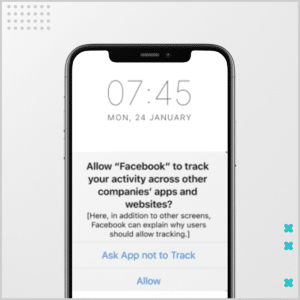
With iOS14 users can activate an option called LAT, limit ad tracking. This means users who opt out of tracking show up as blank data for marketers. Roughly 20% of iOS users cannot be tracked with IDFA because they enabled LAT to date.

Here’s a visual example of the new notification that comes with the update:

So, where does that leave businesses? Does it mean there’s no data to track? Let’s hop onto the next chapter…


Challenges and opportunities with iOS 14

Will all these updates affect the profit and outcomes of your firm’s campaigns? Let’s look at the scale.

Challenges with the iOS14 update

  • It affects marketing performance, specifically PPC efforts like targeting and reporting conversions.
  • It’s changing Facebook’s attribution. The attribution allows marketers and advertisers to see users’ actions after clicking on an ad and before the conversion, giving them a clearer insight as to users’ general behavior during their decision-making process. Before, the attribution was set to 28 days. Now, the attribution is set to only 7 days.
  • It’ll affect the ability to understand and control ad performance.

Opportunities with the iOS14 update

  • Facebook will still allow businesses to track every single conversion event. This means it will follow what you set as a priority, e.g., monitoring users who click to book a call.
  • There will be a higher focus on metrics related to conversion. For example, Facebook will still show you the following: number of purchases, when they were made, how profitable it was, etc.
  • Because Facebook will allow tracking bottom-line results like purchases, the bottom line results will be more relevant. This means that businesses will need to place a little more focus on statistics like the number of purchases and cost per purchase (case). Consequently, many will need new marketing efforts to maximize bottom-line results.
  • The ones doing the most to gather data through, e.g., their website (AKA first-party cookies), are one step ahead. The reason? They’re collecting their data on their own website without relying too much on third-party cookies from Apple.


How law firms can respond to the new iOS14 update

It may seem like your firm is just diving into the unknown with limited data, but it doesn’t have to be this way. To help you brace through, here are 4 actionable steps you can follow:

  1. Leverage 1st party cookies. This means collecting data with the help of cookies instead of solely relying on third-party cookies from Google and such. Although there are many efforts your firm can apply, one excellent action would be to add registration forms across your website. If you’d like to learn more, we’ve previously covered everything your firm needs to know to prepare for a cookie-less future.
  2. Optimize your goals with Google Analytics. You can create Google Analytics goals aligned with what you want to track on Facebook. This is how you’ll get a better vision of the performance metrics you want to measure.
  3. When possible, consolidate campaigns. In other words, it’s best to be attentive and strategic with how many campaigns and ads are launched.
  4. If you are launching many campaigns, A/B tests the frequency and times of the day the ads pop up to the same users.


Move your firm forward

Although users can opt-out of app tracking, they’re still spending just as much time on social media channels, and you can still reach out to them through advertising.

Even though the online ad ecosystem has been disrupted, you can ensure a steady stream of calls and cases by keeping the lines of communication open from all angles, whether that’s social media, your website, or any other channel your audience can communicate with you from. 

If you’d like to learn more about iOS, learn more about legal PPC, check on your firm’s health, or, better yet, create a better strategy for your future campaigns, we’re here to help out.


The post How iOS 14 could affect your ads & what to do about it appeared first on Consultwebs.


from Consultwebs https://www.consultwebs.com/blog/how-ios-14-could-affect-your-ads
via https://www.consultwebs.com

Monday, January 17, 2022

What’s Click Fraud and How Can My Firm Prevent It?

Online advertising has completely changed the way businesses reach clients. This type of marketing effort is widespread because it combines real-time data analysis and closely monitors ad spend. However, the models in online advertising are constantly evolving, but one of the most influential and customizable forms of advertising is PPC. 

PPC for lawyers presents many opportunities for firms investing in marketing. But primarily, your firm can gain online visibility and drive traffic to your site in a shorter period of time (unlike SEO, which focuses on long-term goals). On the other side, with so many businesses leveraging PPC advertising and with money constantly circulating online – it also attracts an increasing number of fraudsters.

To understand how these fraudsters take advantage of online advertisements, it’s best to understand a little more about the advertising models themselves. We’ll focus on Google since it’s #1 in the search engine realm. While most might think the businesses paying the most in advertising get the top positions, this isn’t always the truth. The beauty of PPC is that advertisers cannot simply pay to reach the top position in Google, and this levels the competitive field for small and big law firms competing for visibility. 

Ads go through a series of filters in a bidding system Google calls Ad Auction. The three main factors Google takes into consideration are: 

  1. Your firm’s bid: The maximum amount you’re willing to pay for a click on your ad. 
  2. Your ads’ quality: How relevant are the advertisement and external links, e.g., on your website? Does it offer high-quality, and perhaps even more importantly, relevant content? 
  3. The expected impact from your ad extensions: Ad extensions include things like your phone number, reviews, address, etc.

Now that we’ve explained the basics of PPC, we can dive back into the challenges. Although PPC can bring your firm a number of clients through the door, it can also be costly due to: click fraud. 


What’s click fraud, and should my firm be worried?

According to statistics, over 7 million businesses used Google Ads in 2021 alone, and the number is expected to grow. All these businesses want to get their share of the pie, but the ones that get to feast on the biggest slice are the top 3 paid results; specifically, 41% of clicks go to these 3. But, as great as that sounds, not all clicks are quality leads. Approximately 38% of all web traffic comes from automated bots. 

Bots are one part of click fraud, also known as click theft or fraudulent clicks, is the act of illegally clicking on PPC ads to exhaust a company’s advertising budget. (Remember we previously mentioned one of the main factors in PPC is your firm’s bidding – how much you’re willing to pay/your budget.) This poses the most extensive ad fraud threat for all advertisers. 

Click fraud is frustrating but, should your firm be worried? The answer is: no…as long as you are aware of such a threat, learn how to identify it, and better yet, work with a team of legal marketing experts that’ll actively keep your PPC protected and up to date

On this note, we’d like to tell you that not all hope is lost. Click theft is a severe threat to businesses today, but we’d like to clarify that there are already laws that are being enacted that consider this act a penalty. Under the CFAA, computer fraud and abuse act, there are prison terms and penalties up to $250,000 for individuals and $500,000 for bigger organizations (we’ll explain more of the latter in the following chapters). 

 With that said, we’d like to help you answer another question that might pop up: 

If click theft is a thing, should my firm continue investing in PPC?

Yes, 100%. PPC is powerful and will continue to grow even though challenges like fraudulent clicks exist. Digital advertising is not only replacing traditional advertising. It has surpassed it.

It’s not likely to be replaced anytime soon, especially now due to factors like the pandemic. More and more businesses consider this their lifeline to reach and capture more customers while, e.g., being safe at home. 


So, who’s responsible for click frauds? 

If only we could put a name and a face to this issue, but the reality is that there isn’t a single party responsible for it. There are four types of click frauds:

  1. Competitors: Remember we previously mentioned Google looks at the budget when firms are bidding in an advertisement? Well, other businesses looking to compete for that place can outrun your budget, and this is where it can turn into a ferocious competitive battle. Many firms will place a daily budget to avoid hurting their wallet with PPC. Once the budget is reached, the advertisement will stop appearing. 
  2. Webmasters: Depending on the campaign’s goals, webmasters can purposely click their ads to give themselves more profit. This violates Google Ad Terms of Services, but it still happens today. 
  3. Customers: Although it’s not likely they’ll be clicking on ads to cause harm, some customers might click on the same ad for different reasons, and it can give a false hope that the click-through rate is high, but in reality, it’s the same person. Ideally, you’ll want a potential client to click on the ad and convert, but this isn’t often the case. Please note: some might consider this click fraud, but for the most part, if it’s not a, e.g., a disgruntled customer using up your clicks on purpose, then this could be considered a simple case of invalid clicks
  4. Fraud rings AKA click farms: Although it may seem ‘harmless,’ many operate under a false business offering digital interaction services. Their whole purpose is to generate industrial volumes of clicks. According to Click Cease, most of these click farms are located in countries with unsupervised and minimal labour and employment laws. The majority have been found in countries like China, India, Bangladesh, Russia, Kazakhstan, Indonesia, Venezuela, The Philippines, and South Africa. Although, Europe and the USA are also no exception to the rule.


Signs to see if your firm’s being affected by click theft and what to do about it. 

If you invest in marketing, checking on your firm’s pulse is critical. Your pulse should tell you if something is out of range. To check if your firm’s been a victim of click theft, look at the following in your marketing metrics: 

  1. Distorted campaign metrics: If all of a sudden, your click-through rate went through the roof, calls and cases seemed to stay the same. 
  2. Low ROAS, return on advertisement spent. This is related to the high ad spent and low conversion rate. 


Here’s what your firm can do to stay guarded against click theft: 

  • Study the traffic sources: Where are most clicks coming from? How many are converting? 
  • Once you identify the IP causing abnormal clicks with no conversions, you can block your ad from the associated IP address. 
  • Focus on remarketing campaigns. This means reaching out to customers that have previously interacted with your firm, e.g., signed up or visited your website.
  • Adjust the geographic regions.
  • Check with Google’s Ad Traffic Quality Center. If you report something suspicious, you can then contact Google, and they’ll check the traffic sources, quality, etc. 


Takeaway 

Google ads are by far one of the most essential tools businesses can leverage from, but it’s also open to problems like click fraud. Although Google is constantly trying to introduce new changes, invalid traffic and click fraud are likely to continue in the foreseeable future. 

This affects millions of businesses, no matter their size, and while good bots are trying to fight against the bad bots, there are always new ideas and methods that evade detection. If you’d like to take full advantage of advertising and safeguard your firm at all times, it’s best to partner with a reliable legal PPC agency. If you’d like to learn more about legal PPC, your firm’s digital health, or better yet, start building a robust advertising strategy, we’re here to talk. 


The post What’s Click Fraud and How Can My Firm Prevent It? appeared first on Consultwebs.


from Consultwebs https://www.consultwebs.com/blog/click-fraud-prevention
via https://www.consultwebs.com

Monday, January 10, 2022

How Law Firms can use Data to their Advantage with Josh Blandi of UniCourt


Tanner Jones, your host and Vice President of Business Development at Consultwebs, welcomes you to another episode of the LAWsome Podcast by Consultwebs.


In today’s episode, Tanner is accompanied by Josh Blandi, CEO and Co-Founder of UniCourt, a company that uses machine learning to conveniently access and organize court data for valuable legal intelligence. 


Key Takeaways:

[0:18] Introduction 

[1:22] How is UniCourt different? 

[4:22] What are some other ways law firms can use data to stand out?

[7:36] Using data to attract more clients. 

[8:45] The data infrastructure of law firms.

[10:35] How legal recruiting and data go hand-in-hand 

[14:10] 3 actionable steps to diagnose weaknesses within your firm.

[17:26] How is litigation data being leveraged today?

[19:52] Linking KPIs with data. 

[23:05] Ending thoughts.


Best way to contact Josh Blandi: 

www.unicourt.com 


Discover More About the Podcast and Consultwebs:

Subscribe to the LAWsome Podcast by Consultwebs on Apple Podcasts, Google Podcasts, and Spotify


Visit the LAWsome website


Follow Consultwebs on social for legal marketing updates:

Facebook

Instagram

Twitter

Linkedin

YouTube


Learn more about Consultwebs at the links below.

Law Firm Marketing Agency Services 

Law Firm SEO

Law Firm Web Design 

Law Firm PPC 

Law Firm Social Media 

Law Firm Email Marketing

Law Firm Digital Marketing 


Consultwebs

8601 Six Forks Rd #400, Raleigh, NC 27615

(800) 872-6590

https://www.consultwebs.com 

https://www.google.com/maps?cid=13646648339910389351


The post How Law Firms can use Data to their Advantage with Josh Blandi of UniCourt appeared first on Consultwebs.


from Consultwebs https://www.consultwebs.com/blog/how-law-firms-can-use-data-to-their-advantage-with-josh-blandi-of-unicourt
via https://www.consultwebs.com

How Attorneys Can Find and Add Value to their Legal Practice with Gregory Singleton of Signature Law


Tanner Jones, your host and Vice President of Business Development at Consultwebs, welcomes you to another episode of the LAWsome Podcast by Consultwebs.


In today’s episode, Tanner is accompanied by Gregory Singleton, owner and attorney at Signature Law based in Minnesota. 


Key Takeaways:

[0:18] Introduction 

[00:45] Background information.

[3:08] What drove Gregory towards the estate planning practice 

[5:00] Finding one’s passion within the legal profession. 

[6:35] Dealing with first-time prospective clients. 

[7:55] Using video content in order to tell a story.

[12:03] How attorneys can leverage educational video marketing. 

[16:05] Setting intention and adding value behind video marketing.

[20:40] Tips for attorneys looking to find new ideas for their video content strategy. 

[22:31] More tips for attorneys amping up their video content strategy. 

[23:25] Closing thoughts. 


Best way to contact Gregory Singleton:

gregory@signaturelawpllc.com 


Discover More About the Podcast and Consultwebs:

Subscribe to the LAWsome Podcast by Consultwebs on Apple Podcasts, Google Podcasts, and Spotify


Visit the LAWsome website


Follow Consultwebs on social for legal marketing updates:

Facebook

Instagram

Twitter

Linkedin

YouTube


Learn more about Consultwebs at the links below.

Law Firm Marketing Agency Services 

Law Firm SEO

Law Firm Web Design 

Law Firm PPC 

Law Firm Social Media 

Law Firm Email Marketing

Law Firm Digital Marketing 


Consultwebs

8601 Six Forks Rd #400, Raleigh, NC 27615

(800) 872-6590

https://www.consultwebs.com 

https://www.google.com/maps?cid=13646648339910389351


The post How Attorneys Can Find and Add Value to their Legal Practice with Gregory Singleton of Signature Law appeared first on Consultwebs.


from Consultwebs https://www.consultwebs.com/blog/how-attorneys-can-find-and-add-value-to-their-legal-practice-with-gregory-singleton-of-signature-law
via https://www.consultwebs.com

Everything Your Firm Needs to Know About The Evolution of Web 3.0

Web 3.0 is on its way to becoming the new paradigm of the Internet. Some argue that Web 3.0 is already here – at least the initial stages of it. We’ll give you a quick recap of what this means and, more so, what it means for your law firm. 


Every so often, the Internet evolves. Just think back to the early 1990s when the Internet’s primary purpose was to share information (anybody remember Windows XP? We sure do…). Ever since then, the Internet has grown and continues to do so. Web 1.0 was coined by Tim Berners Lee, the Web’s original inventor. Following closely, we found ourselves working with Web 2.0, which is also where we currently stand. Web 2.0 focuses on interactivity, and under this umbrella, many tech giants like Facebook, Twitter, Instagram, TikTok, and YouTube were born. What’s more, during the era of Web 2.0, other giants like Amazon and Google grew to insurmountable proportions and virtually exploded! The Internet is evolving as we speak, and this is where Web 3.0 comes in. 


Web 3.0 integrates automation, live tools, and AI management into the digital culture. All in all, this new process aims at understanding humans better and provides us, the users, with much more relevant and faster results. This means two things for law firms: 

  • From the customer’s point of view, they’ll connect to the Internet and get an even more personalized search results page. In addition, they’ll get an even more customized user experience with the help of, e.g., chatbots or AI-driven scheduling tools.
  • From the law firm’s point of view, they’ll be more accessible to potential clients online. Consequently, firms can reach more potential clients, expand their business, network, reach, and pretty much expand across all horizons. 


The nature of Web 3.0 is still complex, growing, and largely unknown. Therefore, we’ve decided to break down all the findings that we could find for you, and bring you the most reliable information with what the world currently knows about Web 3.0 and what this entails for your firm. In our first part of Web 3.0 for law firms, we covered the history of Web 1.0, Web 2.0, and what Web 3.0 implies. In addition to that, we also provided six actionable steps so your firm prepares for Web 3.0


Now that we’ve covered the basics, let’s start peeling the rest of the layers. 

What are the secret ingredients of Web 3.0?

What are the characteristics and properties of Web 3.0? 


For starters, the first noticeable characteristics under Web 3.0 are: 

  1. Open: Anyone in the world should be able to access records. 
  2. Trustless: Users will interact publicly or privately without using a third party, e.g., Facebook. This is a significant shift from Web 2.0. Under today’s Web, big giants like Google, Facebook, and Amazon dominate the Internet. All the user data collected by them is then sold to others, and this is a growing data privacy concern for users. Under Web 3.0, it is predicted that users will own their data or at least have much more transparency when it comes to who owns their data and what’s being done with it.
  3. Permissionless: Similar to the previously mentioned point, anyone can participate without a governing body, e.g., without the big tech giants. In other words, it aims at becoming decentralized.


In addition to these characteristics, the properties that make up Web 3.0 include: 

  1. Semantic Web: This is an extension of the world wide web, and it allows users to create, share, and connect. This is based on understanding the real meaning behind keywords and numbers placed in the search bar. 
  2. 3D Graphics: They will be widely used in websites, online video games, e-commerce sites, etc. It’s similar to the metaverse concept. 
  • Metaverse is a technology that implements augmented reality, virtual reality, and video – in other words, people can work and interact in these virtual settings. Facebook changed its name to Meta for a reason:they want to build a metaverse of their own. They’re prepared for Web 3.0 and aim to help users take their accounts/avatars from site to site.
  1. Artificial Intelligence: Specifically, natural language processing (NLP) allows computers to comprehend language in the way we speak it. For example, if we search the Web for ‘Apple,’ we could get two completely different results: either the fruit or the tech company. NLP aims to understand the context of the user’s search intent and provide quicker and more relevant results.


What are the opportunities and challenges with Web 3.0?


One of the main benefits of Web 3.0 is that prospects will be able to explore the Web with more complex search queries. Other noticeable opportunities with Web 3.0 include: 

  • Better business opportunities will emerge due to faster and more efficient search results. Plus, it’s good to remember that being found online is key to your firm’s survival. 
  • New technology will facilitate your business processes, e.g., chatbots that answer FAQs or more relevant advertisements. 
  • Better security from hackers.
  • Trust from your users since they’ll have more control over the usage of their own data. 


However, there are some challenges with Web 3.0, and that includes: 

  • The population is increasingly wanting more privacy and transparency. They want to know where and how the data is used. 
  • Although this new Web aims at being decentralized, our current Web is dominated by big giants, so it’s difficult to discern what this new decentralized format will look like. 
  • It’s still in its early stages; therefore, it’s challenging to determine what’s to come with absolute certainty.

Why does Web 3.0 matter? 

Although there are challenges and gaps to fill in, Web 3.0 matters, there’s a growing increase of users concerned with their data privacy. Studies have shown that an increasing number of users are concerned with their data privacy. To be exact, based on a study, 86% of respondents feel a growing concern about their data privacy. Additionally, 78% expressed fear about the amount of data collected. This is a significant concern for not only users, but for businesses as well. On one side, enterprises need data to give the users the most optimized and personal experience. On the other side, users increasingly distrust companies with their data, in part due to data leaks and lack of transparency. This is a problem that Web 3.0 aims at solving. 


Although this is still in the works, your firm can take some actionable steps to secure privacy today:

  • Be more transparent with what you’re doing with your users’ data. 
  • Give users more control of their data. This means allowing the user to opt out of sharing some of their more sensitive data. 
  • Create a corporate data responsibility page on your website and explain how the data is used and protected.

Move Faster, Better, and Stronger.

Although it’s still not 100% clear how long it will take to reach a fully functioning Web 3.0, one thing is certain: Web 3.0 will change our lives both personally and professionally. As we dive deeper into the Web 3.0 era, online will be an even more indispensable part of our everyday lives. On top of that, more and more users are opting to search for online services. This implies your firm’s digital efforts must be optimized to fit these upcoming new norms. 


As Web 3.0 evolves, so must your firm – you will need to move faster, better and stronger today and tomorrow with the help of legal digital marketing experts by your side to ensure your spot as an industry leader. While we hope our blog posts offer the latest and most enriching legal marketing information, we also understand that putting in the actual marketing plan to work by yourself requires a mass amount of effort, expertise, and time. But, worry not! Whether you have more questions about Web 3.0, comments, ideas, or, better yet, want to get a head start, our legal marketing experts are always here to help.


The post Everything Your Firm Needs to Know About The Evolution of Web 3.0 appeared first on Consultwebs.


from Consultwebs https://www.consultwebs.com/blog/the-evolution-of-web-3-0
via https://www.consultwebs.com

How Law Firms can use Data to their Advantage

Tanner Jones, your host and Vice President of Business Development at Consultwebs, welcomes you to another episode of the LAWsome Podcast by Consultwebs.


In today’s episode, Tanner is accompanied by Josh Blandi, CEO and Co-Founder of UniCourt, a company that uses machine learning to conveniently access and organize court data for valuable legal intelligence. 


Key Takeaways:

[0:18] Introduction 

[1:22] How is UniCourt different? 

[4:22] What are some other ways law firms can use data to stand out?

[7:36] Using data to attract more clients. 

[8:45] The data infrastructure of law firms.

[10:35] How legal recruiting and data go hand-in-hand 

[14:10] 3 actionable steps to diagnose weaknesses within your firm.

[17:26] How is litigation data being leveraged today?

[19:52] Linking KPIs with data. 

[23:05] Ending thoughts.


Best way to contact Josh Blandi: 

www.unicourt.com 


Discover More About the Podcast and Consultwebs:

Subscribe to the LAWsome Podcast by Consultwebs on Apple Podcasts, Google Podcasts, and Spotify


Visit the LAWsome website


Follow Consultwebs on social for legal marketing updates:

Facebook

Instagram

Twitter

Linkedin

YouTube


Learn more about Consultwebs at the links below.

Law Firm Marketing Agency Services 

Law Firm SEO

Law Firm Web Design 

Law Firm PPC 

Law Firm Social Media 

Law Firm Email Marketing

Law Firm Digital Marketing 


Consultwebs

8601 Six Forks Rd #400, Raleigh, NC 27615

(800) 872-6590

https://www.consultwebs.com 

https://www.google.com/maps?cid=13646648339910389351


The post How Law Firms can use Data to their Advantage appeared first on Consultwebs.


from Consultwebs https://www.consultwebs.com/blog/how-law-firms-can-use-data-to-their-advantage
via https://www.consultwebs.com